- Employing unsupervised learning techniques for the analysis and
curation of crystal structure databases, whether obtained
experimentally or through ab initio calculations.
- Developing and benchmarking supervised machine learning models
for predicting materials properties. This involves tailoring
models with inductive biases (for limited datasets),
incorporating epistemic uncertainty, and utilizing
multi-fidelity methods.
- Implementing active learning strategies to accelerate
experimental processes.
- Progressing toward fully automated high-throughput DFT
calculations using artificial intelligence agents.
- Utilizing generative algorithms for the creation of stable
crystal structures.
- Designing crystals for applications in solid electrolytes and
electrocatalysis.
- Conducting high-throughput Density Functional Theory (DFT) and
DFPT analysis.
Published tools
- Matra-Genoa App A web
app for generating new crystal structures.
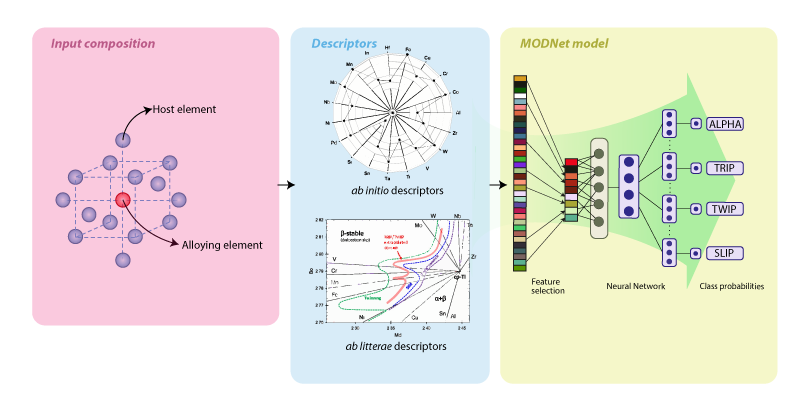
 A supervised machine learning framework for learning material properties
from either the composition or crystal structure. The framework is
well suited for limited datasets and can be used for learning multiple
properties together by using joint learning.
A supervised machine learning framework for learning material properties
from either the composition or crystal structure. The framework is
well suited for limited datasets and can be used for learning multiple
properties together by using joint learning. Plasticty Predictor App A simple web application for predicting the joint activation of
the TRIP and TWIP effects in Titanium alloys for improved work hardening.
Plasticty Predictor App A simple web application for predicting the joint activation of
the TRIP and TWIP effects in Titanium alloys for improved work hardening.- B2 Predictor App A simple web app for predicting the probability of B2-phase crystallization.